HARDWARE • SOFTWARE • SYSTEMS

Understand the technology
around you.

Explore the engineering inside everyday products, machines and connected systems — then learn how to build them.

Explore courses →
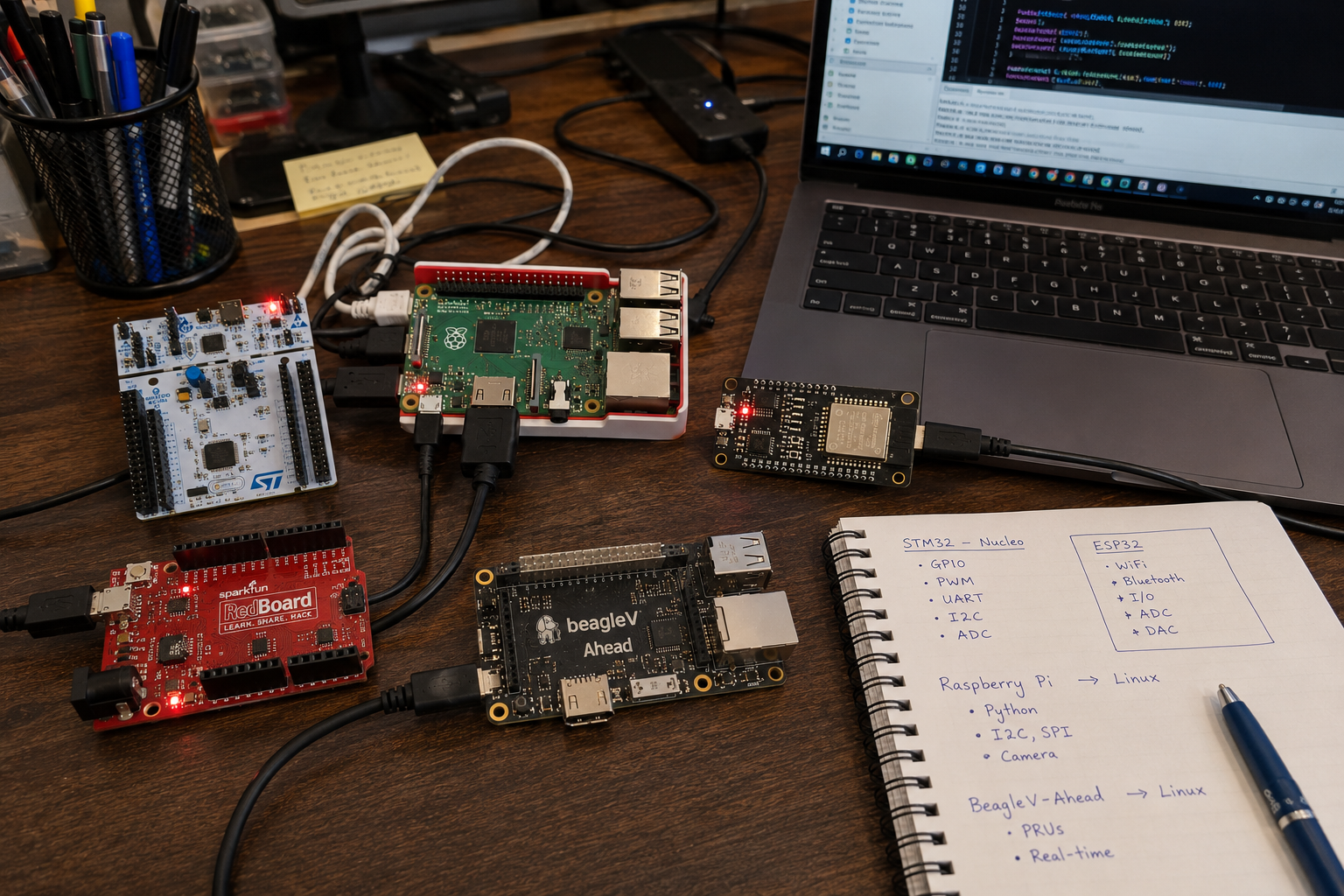
Embedded systems and electronics workspace
LOOK AROUND

Look closer.
See what's inside.

From the devices you use at home to the machines that power industries, embedded systems quietly make modern life work.

SAME PRINCIPLES. EVERYWHERE.

Different products and systems may look completely different, but the same engineering principles keep working behind them — sensing, processing, communication and control.

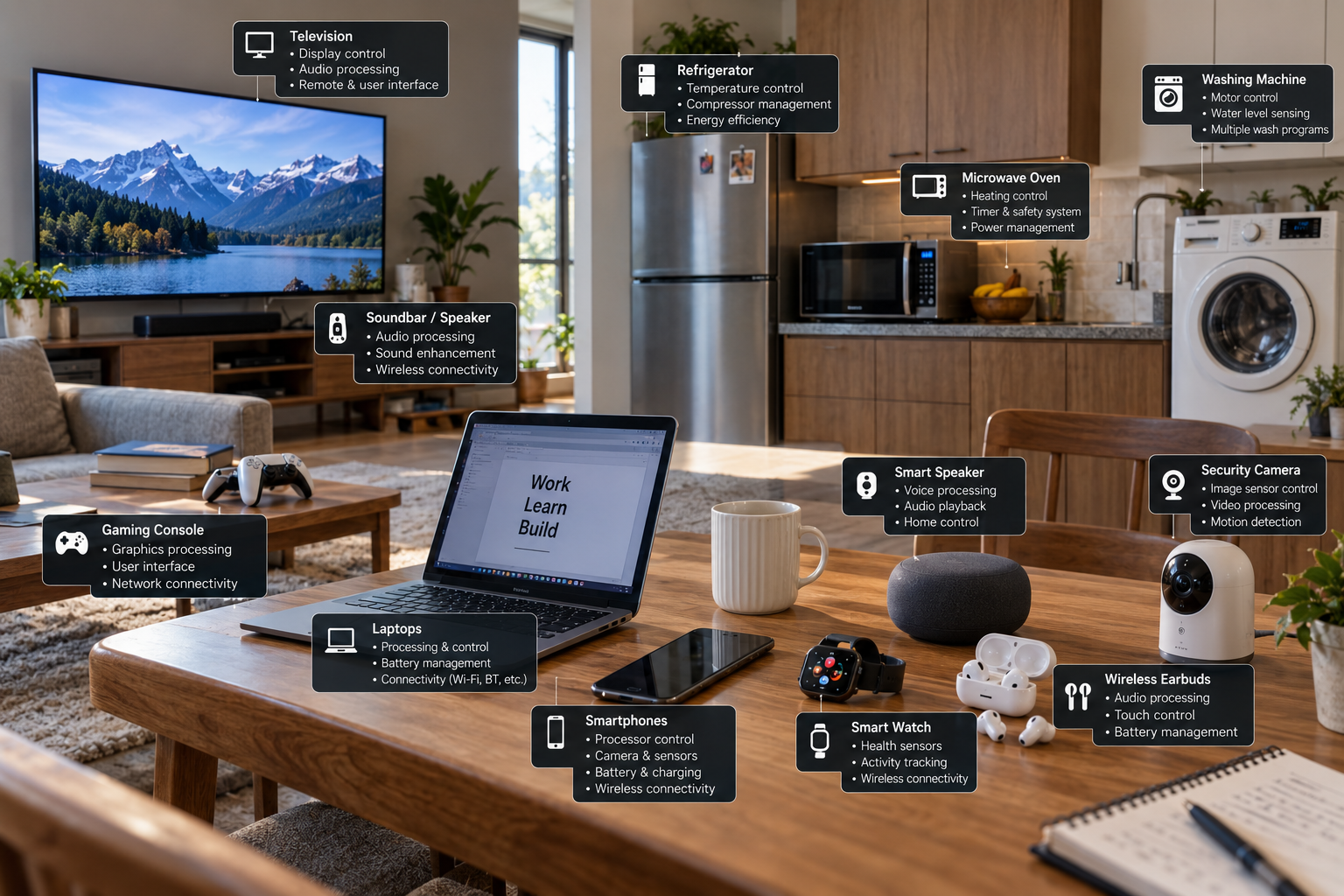
Everyday devices powered by embedded technology
01 / 05

Consumer Electronics

Everyday devices powered by embedded systems.

Embedded systems are inside the electronic products people use every day, combining processors, sensors, firmware and electronics to perform specific functions.

◌
Smart Appliances Controllers manage device functions
▣
Personal Devices Processors power everyday electronics
⌘
Sensors & Interfaces Devices detect input and user actions
⚙
Device Control Firmware coordinates hardware operation
THE ENGINEERING PIPELINE

Where does
embedded
engineering fit?

Embedded engineering connects physical hardware with the software that makes a product work.

01
FOUNDATION

Hardware

VLSI · PCB · Sensors · Actuators

  • VLSI & IC Design
  • PCB Design
  • Sensors
  • Actuators
02
CORE EMBEDDED LAYER

Embedded Engineering

MCU · Firmware · Drivers · RTOS · Embedded Linux

  • Microcontrollers (MCU)
  • Firmware Development
  • Device Drivers
  • RTOS
  • Embedded Linux
03
SYSTEM SOFTWARE

Software & Connectivity

Edge · Cloud · Backend · Communication

  • Embedded Software
  • UART · I2C · SPI
  • Edge Computing
  • Cloud Integration
  • Backend Systems
04
PRODUCT LAYER

Applications

IoT · Robotics · EV · Industrial

  • IoT Systems
  • Robotics
  • Electric Vehicles
  • Industrial Automation
  • Consumer Electronics
05
OUTCOME

Real-World Products

Smart Devices · Automotive · Industrial · Connected Products

  • Smart Devices
  • Automotive Systems
  • Industrial Systems
  • Connected Products

Solve real problems and create impactful solutions.

HOW WE TEACH

From fundamentals
to real systems.

Start with the fundamentals, understand how technologies work, work with real tools and gradually build complete systems.

01

Understand the fundamentals

Learn the core concepts of electronics, programming, embedded systems, communication and computing.

FOUNDATION
02

Work with real tools

Use development boards, sensors, software tools, debuggers and interfaces to turn concepts into working systems.

TOOLS
03

Build complete systems

Combine hardware, software and communication to create projects that behave like real engineering systems.

PROJECTS
04

Debug and solve problems

Learn to read failures, trace problems and improve systems using the same thinking engineers use in practice.

PROBLEM SOLVING
05

Go deeper

Move from basic concepts into advanced technologies, larger systems and more demanding engineering projects.

PROGRESSION

COURSES

Turn Ideas Into Systems.

COURSE 01

Embedded Systems

Learn how software, microcontrollers and hardware work together to build reliable embedded systems.

Topics
  • C foundations
  • Pointers & memory
  • Structures, unions & enums
  • Bit manipulation
  • Function pointers & callbacks
  • Modular C programming
  • Embedded C practices
Practical
  • Memory & pointer exercises
  • Bit manipulation lab
  • Multi-file C application
  • Debugging exercises
Mini Project

Embedded Device Configuration Manager

Outcome

Write structured, memory-aware C code for embedded applications.

Topics
  • MCU architecture
  • Registers & memory map
  • GPIO
  • Timers & counters
  • Interrupts
  • ADC & PWM
Practical
  • GPIO control
  • Timer configuration
  • Interrupt handling
  • ADC & PWM exercises
Outcome

Program and control microcontroller peripherals confidently.

Topics
  • UART
  • SPI
  • I²C
  • CAN
  • Protocol fundamentals
  • Peripheral communication
Practical
  • UART communication
  • SPI device interface
  • I²C sensor interface
  • CAN communication exercise
Outcome

Interface and troubleshoot common embedded communication buses.

Topics
  • Tasks & scheduling
  • Context switching
  • Queues
  • Semaphores
  • Mutexes
  • Inter-task communication
Practical
  • Task creation
  • Task synchronization
  • Queue-based communication
  • RTOS debugging
Outcome

Design and debug multitasking embedded applications.

Topics
  • Linux fundamentals
  • Shell & command line
  • Processes & threads
  • GCC
  • Make
  • Cross-compilation
Practical
  • Linux development environment
  • Build automation
  • Process programming
  • Cross-compilation exercises
Outcome

Develop and build software for Linux-based embedded platforms.

Topics
  • POSIX programming
  • Threads
  • Synchronization
  • IPC
  • System calls
  • Socket programming
Practical
  • Multi-threaded applications
  • IPC exercises
  • Socket programming
  • System-level debugging
Outcome

Build Linux applications using system-level programming concepts.

Topics
  • Debugging techniques
  • JTAG & SWD
  • Board bring-up
  • Hardware troubleshooting
  • System integration
Practical
  • Breakpoint debugging
  • Fault analysis
  • Board bring-up exercises
  • Hardware/software integration
Outcome

Debug, troubleshoot and integrate real embedded systems.

CAPSTONE PROJECT

Build a Complete Embedded System

Bring together Embedded C, microcontrollers, communication protocols, RTOS, Embedded Linux and debugging into one complete system.

FINAL OUTCOME

Design, develop, debug and integrate production-oriented embedded systems across the complete software and hardware stack.

CERTIFICATION
Certificate of Completion

Receive a CoreNCode Certificate of Completion after successfully completing the course and meeting the required completion criteria.

Register Now →
WORKSHOP

IoT Workshops

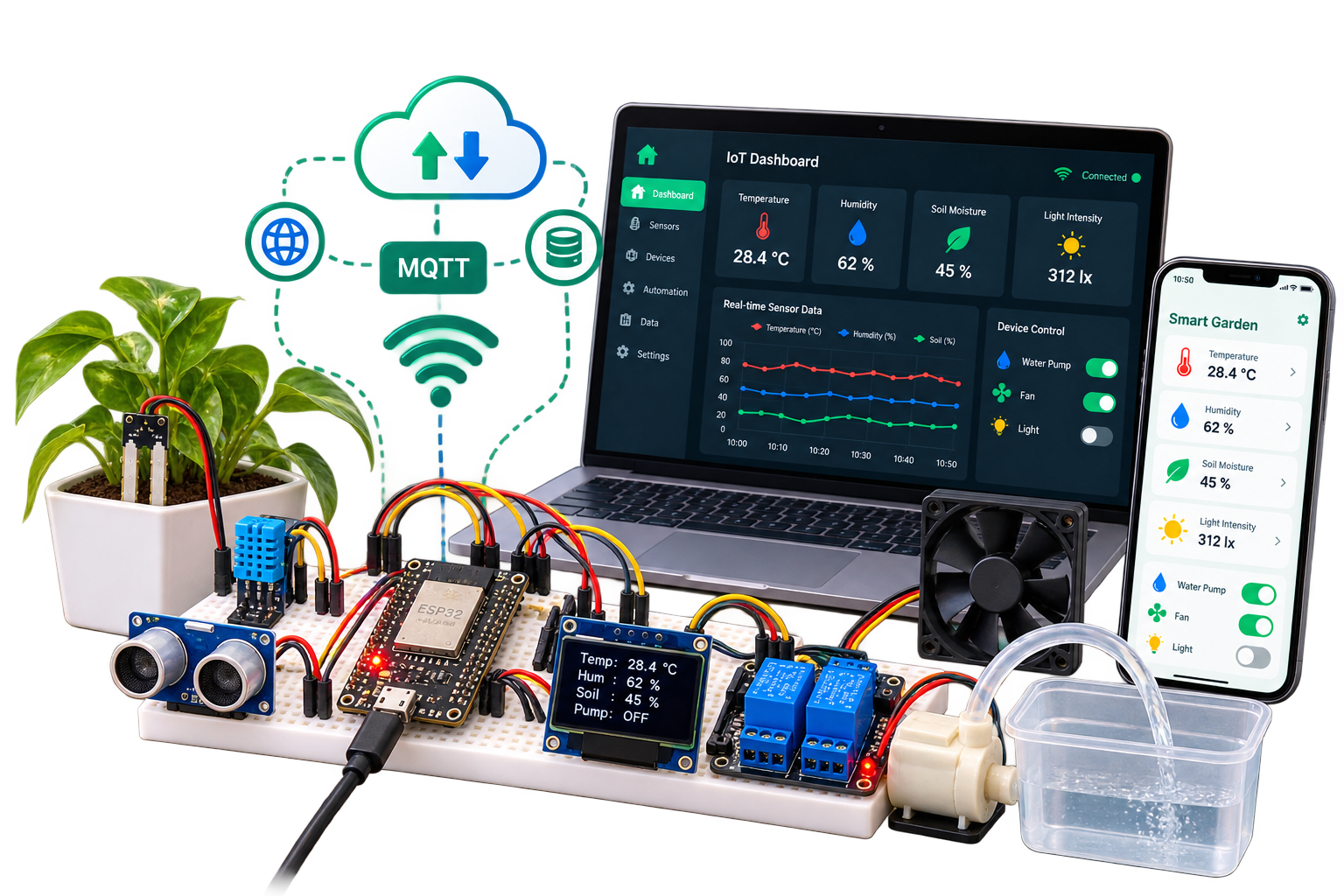
Learn how devices sense, communicate and respond — from IoT fundamentals to connected systems, robotics and automation.

Topics
  • ESP32 Development & Hardware Setup
  • Electronics & Breadboard Prototyping
  • Arduino IDE & Embedded Programming
  • GPIO, Digital & Analog Interfacing
  • Sensors & Actuator Integration
  • Sensor Data Acquisition & Display
  • Wi-Fi Connectivity & Networking
  • End-to-End IoT Project Development
Certification Certificate of Completion

Awarded after completing the Level 1 practical work, final project and required course activities.

Practical
  • ESP32 hardware setup
  • Sensor interfacing
  • Digital & analog data acquisition
  • Sensor data display
  • Wi-Fi connectivity
  • Basic web dashboard integration
Final Project

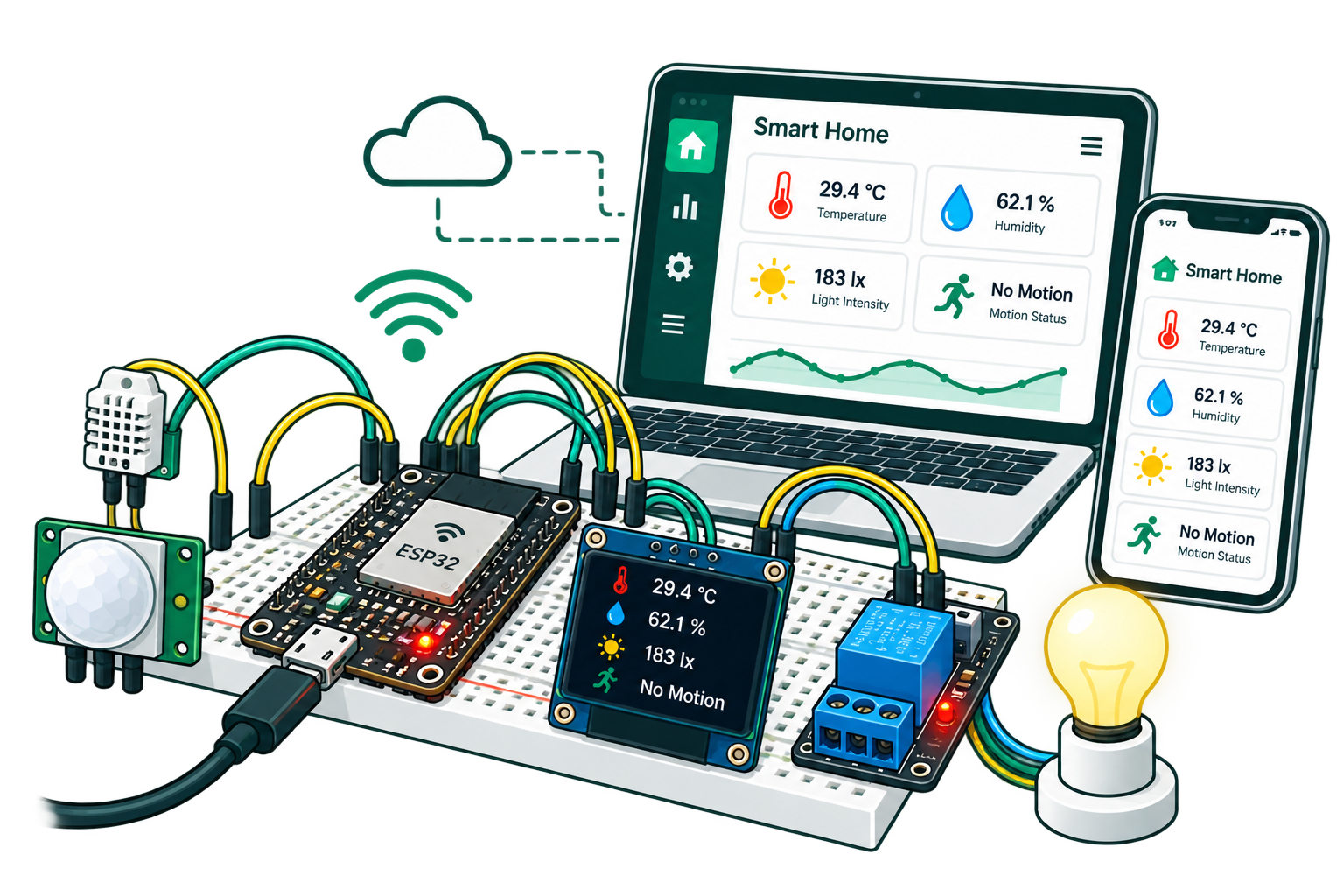
Smart Home Monitoring System
Build an ESP32-based monitoring system using multiple sensors, local display and Wi-Fi connectivity.

Outcome

Build basic IoT devices with sensor integration, data acquisition and wireless connectivity.

Level 01 IoT Foundations project
Topics
  • Advanced ESP32 Development
  • Advanced Sensors & Peripheral Integration
  • Wireless Communication & Networking
  • MQTT & Connected IoT Systems
  • Remote Monitoring & Data Integration
  • IoT Automation & Control
  • Connected IoT System Design
  • Integrated IoT Project
Certification Certificate of Completion

Awarded after completing the Level 2 practical work, final project and required course activities.

Practical
  • Advanced ESP32 interfacing
  • Wireless device communication
  • MQTT-based data exchange
  • Remote sensor monitoring
  • Dashboard integration
  • IoT automation and control
Final Project

Remote IoT Monitoring & Automation System
Build a connected system that collects sensor data, communicates remotely and controls devices through an IoT interface.

Outcome

Design connected IoT systems capable of remote monitoring, data exchange and automated control.

Level 02 Connected IoT Systems project
Topics
  • Motor Drivers & Power Control
  • Servo & Actuator Systems
  • Robotics Sensors & Interfacing
  • Motor Control & Motion Systems
  • Robotics & Automation Fundamentals
  • Line Following & Obstacle Avoidance
  • Robotic System Integration
  • Robotics & Automation Project
Certification Certificate of Completion

Awarded after completing the Level 3 practical work, final project and required course activities.

Practical
  • Motor driver interfacing
  • DC motor control
  • Servo control
  • Robotics sensor integration
  • Line following
  • Obstacle detection and avoidance
FINAL PROJECT

Autonomous Line Following & Obstacle Avoidance Robot
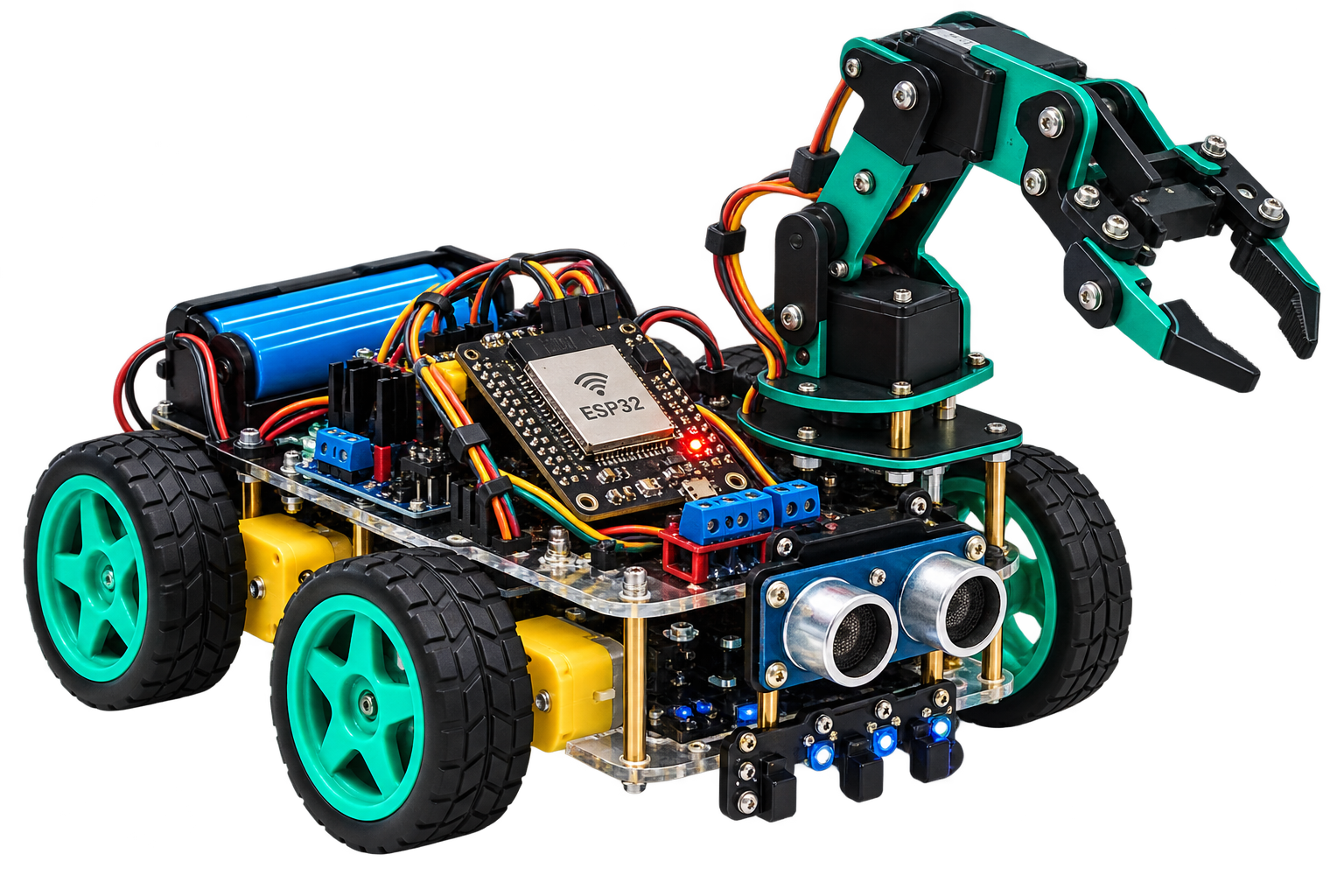
Build and integrate a mobile robot using sensors, motor drivers and control logic for autonomous movement.

Outcome

Build and integrate robotic systems using sensors, motors, actuators and embedded control.

Level 03 Robotics and Automation project
Register Now →
COURSE 03

Linux Systems

Learn how Linux works from the command line to system-level programming, processes, networking and embedded Linux development.

Topics
  • Linux architecture
  • Linux distributions
  • File system hierarchy
  • Shell & terminal
  • Users & permissions
  • Processes
  • Environment variables
Practical
  • Command-line navigation
  • File and directory operations
  • Permissions management
  • Shell commands and pipelines
Mini Project

Linux System Administration Toolkit

Outcome

Work comfortably with Linux systems and command-line based development environments.

Topics
  • Process lifecycle
  • Process IDs
  • Fork & exec
  • Signals
  • Threads
  • Scheduling fundamentals
Practical
  • Process creation
  • Signal handling
  • Thread creation
  • Multi-threaded programs
Mini Project

Multi-Process System Monitor

Outcome

Understand and build Linux applications using processes and threads.

Topics
  • System calls
  • File descriptors
  • Files & I/O
  • Memory management
  • POSIX APIs
  • Timers
Practical
  • File I/O programming
  • System-call exercises
  • Memory handling
  • Timer-based applications
Mini Project

Linux Log Monitoring Utility

Outcome

Build applications that interact directly with Linux system services.

Topics
  • Pipes
  • Message queues
  • Shared memory
  • Semaphores
  • Socket programming
  • TCP/IP fundamentals
Practical
  • IPC exercises
  • Producer-consumer application
  • TCP client-server
  • Socket debugging
Mini Project

Linux Client-Server Communication System

Outcome

Build Linux applications that communicate locally and across networks.

Topics
  • GCC
  • Make
  • Build systems
  • Libraries
  • Cross compilation
  • Target architectures
Practical
  • Makefile development
  • Library linking
  • Cross-compiler setup
  • Target application builds
Mini Project

Cross-Platform Embedded Linux Build

Outcome

Build and deploy Linux applications for different embedded target platforms.

Topics
  • Embedded Linux architecture
  • Boot process
  • Device tree fundamentals
  • Kernel basics
  • Device drivers
  • Board bring-up
Practical
  • Linux board setup
  • Device tree exercises
  • Driver interaction
  • Hardware bring-up
FINAL PROJECT

Embedded Linux Hardware Integration System
Build a Linux-based embedded application that communicates with hardware peripherals and system interfaces.

Outcome

Understand how Linux connects to real embedded hardware and system-level software.

Register Now →
COURSE 04

C Programming

Build strong programming fundamentals with C and develop the problem-solving skills used in embedded systems, firmware, Linux, and systems programming.

Topics

C program structure, variables, data types, constants, input/output, operators, expressions, type conversion.

Practical

Write, compile, run, debug, and modify basic C programs using real programming exercises.

Mini Project

Create a simple menu-driven utility program using variables, operators, conditions, and user input.

Outcome

Understand how a C program is structured and develop confidence in writing basic programs independently.

Topics

if, else, else-if, switch, for, while, do-while, nested loops, break, continue, logical thinking.

Practical

Solve decision-making and looping problems through progressively harder programming exercises.

Mini Project

Build a simple calculator and menu-driven application using conditions and loops.

Outcome

Develop structured problem-solving skills and understand how program execution flows through different conditions.

Topics

Function declaration, definition, parameters, return values, arrays, multidimensional arrays, strings, common string operations.

Practical

Break larger problems into reusable functions and work with arrays and strings through coding exercises.

Mini Project

Build a student record program using arrays, strings, functions, and menu-driven operations.

Outcome

Write modular C programs that are easier to understand, test, debug, and maintain.

Topics

Addresses, pointers, pointer arithmetic, pointers with arrays, strings, functions, structures, dynamic memory.

Practical

Trace addresses and memory using debugger-based exercises and pointer programming problems.

Mini Project

Create a simple memory-based data management program using pointers and structures.

Outcome

Understand memory addresses, pointers, and why C is widely used in embedded and systems programming.

Topics

Structures, nested structures, typedef, unions, enumerations, file operations, reading and writing data.

Practical

Design structured data models and store or retrieve information using files.

Mini Project

Build a simple student or inventory management system using structures and file handling.

Outcome

Organize and manage structured information using practical C programming techniques.

Topics

Bitwise operations, registers, bit manipulation, volatile, memory concepts, embedded coding practices, hardware-oriented programming.

Practical

Perform bit-level operations and write hardware-oriented C programs using a microcontroller environment.

Final Project

Develop a small embedded C application that reads an input, processes it, and controls a hardware output.

Outcome

Build a strong C foundation for embedded systems, firmware development, Linux, and systems programming.

Register Now →
COURSE 05

Python

Learn Python from fundamentals to practical programming, automation, data handling, and technology-focused applications.

Topics

Python syntax, variables, data types, operators, input/output, type conversion, basic expressions.

Practical

Write and execute small Python programs using a development environment and command line.

Mini Project

Build a simple command-line utility using variables, calculations, and user input.

Outcome

Understand Python syntax and confidently write basic programs.

Topics

if, elif, else, for, while, range, break, continue, functions, parameters, return values.

Practical

Solve programming problems using conditions, loops, and reusable functions.

Mini Project

Create a menu-driven application using conditions, loops, and functions.

Outcome

Develop structured problem-solving skills and reusable Python programs.

Topics

Lists, tuples, dictionaries, sets, indexing, slicing, iteration, comprehensions, common collection methods.

Practical

Process, search, update, sort, and organize collections of real-world data.

Mini Project

Build a contact or student management program using Python collections.

Outcome

Manipulate and organize data efficiently using Python's built-in collection types.

Topics

File handling, text data, JSON basics, exceptions, try/except, modules, packages, imports.

Practical

Read, write, update, and validate data while handling common runtime errors.

Mini Project

Build a small record-management application that saves and loads data from files.

Outcome

Create more reliable Python applications with persistent data and proper error handling.

Topics

Automation concepts, command-line tasks, subprocesses, directories, basic scripting, working with system data.

Practical

Automate repetitive file, directory, and system-related tasks using Python scripts.

Mini Project

Create an automation utility that organizes files or performs repetitive system tasks.

Outcome

Use Python as a practical tool for automation, productivity, and technology workflows.

Topics

Python in embedded workflows, testing, automation, data processing, APIs, and technology applications.

Practical

Use Python scripts to interact with files, tools, test environments, and technical workflows.

Final Project

Develop a practical Python automation or technology utility that combines multiple concepts from the course.

Outcome

Build a practical Python foundation that can support automation, embedded workflows, data, and future AI/ML learning.

COURSE 06

AI / ML

Explore the technologies shaping intelligent systems, automation, data-driven applications, and the future of connected technology.

Coming Soon

The complete AI / ML curriculum, practical sessions, projects, and learning roadmap will be announced soon.

ABOUT CORENCODE

Built around
practical engineering.

CoreNCode is a technology education brand focused on helping students understand how real technology is built — from electronics and embedded systems to connected and intelligent products.

We believe engineering becomes meaningful when you can understand it, build it, debug it and connect it to the real world.

UNDERSTAND BUILD DEBUG INTEGRATE

MEET THE FOUNDER

From building
systems
to building
engineers.

Embedded Systems Engineer · Firmware Developer · Mentor

Hands-on experience across embedded firmware, Embedded C, Linux, board bring-up, microcontrollers, hardware interfaces, debugging, and system integration.

Focused on building practical engineering skills through real hardware, real tools, and real projects.

Founder

Mohammed Muzamil Nawaz

FAQ

Questions, answered.

Our courses are designed for students, beginners, engineering learners, and anyone interested in practical electronics, embedded systems and technology.

It depends on the course. Beginner workshops start from the fundamentals, while advanced courses may require basic programming or electronics knowledge.

We work with different microcontrollers and development boards such as ESP32 and STM32 Nucleo boards, along with sensors, peripherals and other hardware.

Yes. The focus is on building, testing and debugging real systems rather than learning only through theory.

You will work with development environments, compilers, debuggers, programming tools and hardware debugging tools relevant to the course.

Yes. We provide guidance from project selection and hardware planning through development, debugging, documentation and demonstration.

Use the registration link provided with the relevant course or contact us for more information.

CONTACT

Let's build something
that works.

Have a question about a course, workshop or project?

Location Chitradurga, Karnataka
Email CoreNCodelabs@gmail.com
Phone / WhatsApp +91 94491 72318
Reach out to us
Get in touch →